Adaptive Software
Generative UI Grows Up: What Monogram's Launch Signals

For three years, "using AI" has meant one thing: typing into a box and reading back a wall of text. The chat window won the first round of consumer AI so completely that we stopped noticing it was a design choice. This week, a well-funded bet against that assumption stepped out of stealth.
On July 7, 2026, Eren Bali, Edouard Tabet, and Murat Akbal launched Monogram, an iPhone app that answers questions with a generated, interactive interface instead of a chat thread, alongside a $40 million seed round led by DST Global and Lux Capital. Bali, who previously co-founded Udemy and Carbon Health, framed the raise as Monogram's exit from stealth. The company's own framing is the thesis: "Just as the transition from the command line to graphical user interfaces transformed personal computing, we believe making AI easier to use will help it benefit more people."
That points at a category quietly maturing under a name most people outside product and engineering haven't heard yet: generative UI. It's also the leading edge of a shift that runs deeper into the stack — and the layer beneath it, the one we work on, only becomes possible once generative UI takes hold.
Subscribe to Adaptive Software
Deep dives on generative UI, adaptive interfaces, and where software is heading — straight to your inbox.
What Generative UI Actually Means
Generative UI (or "GenUI") is the idea that an AI system shouldn't just generate text or images — it should generate the interface itself, on the fly, tailored to the request. Ask a normal chatbot to plan a trip and you get paragraphs. Ask a generative UI system and you get an interactive map, a rearrangeable itinerary, and filters for budget and pace — a purpose-built app assembled in seconds.
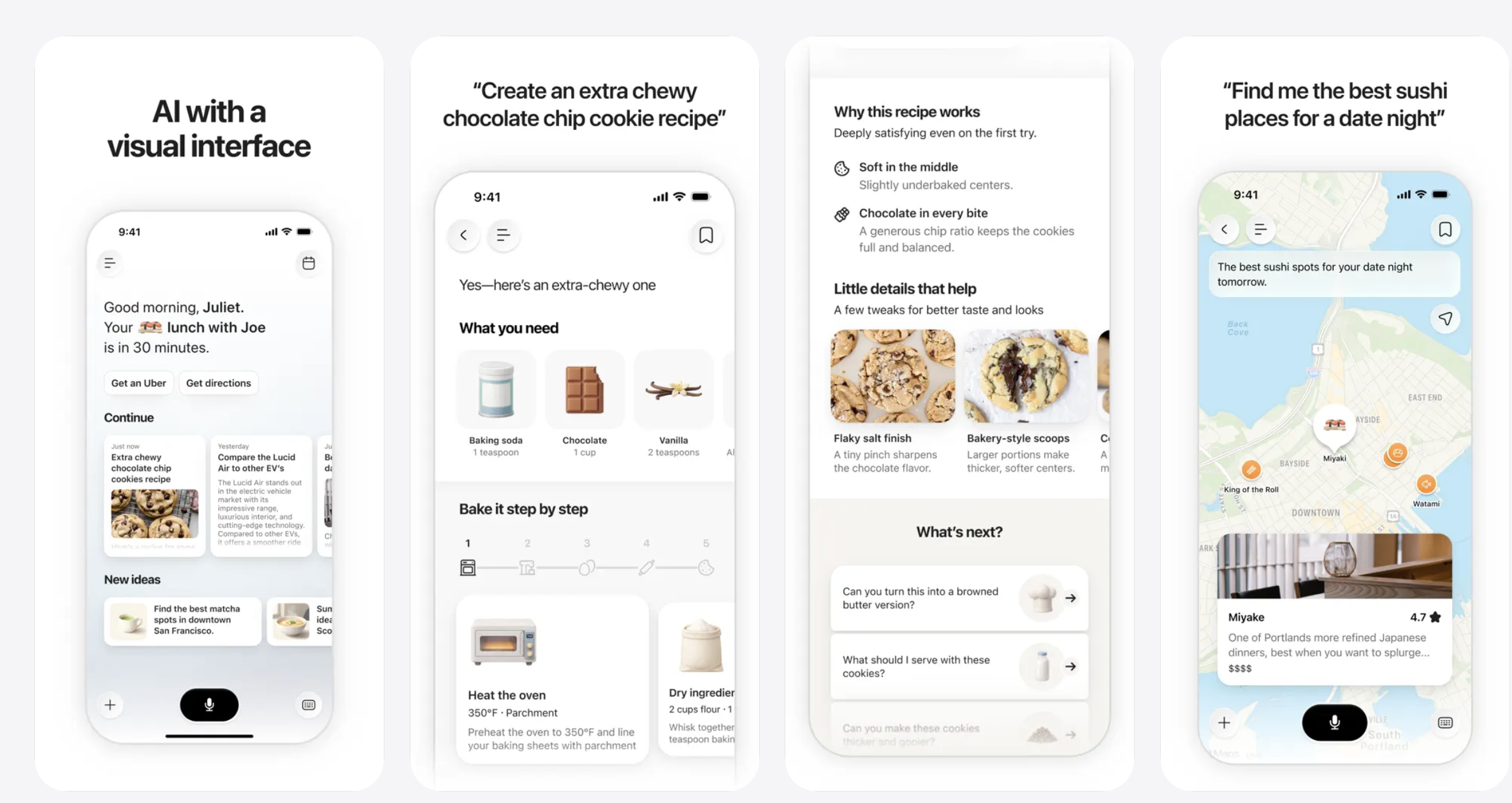
Monogram answers a request with a generated, interactive interface — a step-by-step recipe, a map of the best sushi spots — instead of a chat reply. Source: Monogram.
Text is a lossy format for a lot of what people want to do. Comparing electric vehicles, choosing what to watch, or scaling a recipe are interactive tasks, and rendering them as prose forces the user to do the reassembly in their head. It's why Monogram's use cases are so deliberately mundane — these aren't frontier reasoning problems, they're everyday tasks where a visual, manipulable response beats a paragraph, and where the current interface quietly fails millions of people who don't want to become skilled prompt-writers.
Why This Is a Real Trend, Not a Single App
Generative UI has been converging from several directions at once, and Monogram is the most visible consumer bet so far. Frameworks for streaming AI-generated components into live interfaces moved from experimental to production-ready over the past year. Monogram is what happens when someone builds a whole consumer product around that, rather than bolting dynamic widgets onto a chat transcript.
The strategic logic holds too. Monogram is entering consumer AI without owning a frontier model — a notable choice when ChatGPT, Gemini, Claude, and Perplexity already sit on enormous user habits. The bet is that the next defensible layer is the interface: where user intent, context, and trust get translated into action. If model quality keeps commoditizing, value may accrue less to whoever has the best weights and more to whoever owns the moment a person actually asks AI to do something.
The question splits into two versions — one Monogram is answering now, and a longer-horizon one that sits a layer below it.
From Generated Interfaces to Adaptive Software
Generative UI generates a response. Each interface is assembled fresh for a single request and thrown away after — brilliant for the one-off task, the trip you'll plan once. The unit of personalization is the query.
Adaptive software generates the product. Instead of a disposable interface per request, the deployed app itself diverges and persists per user — its logic, flows, and interface reshaping around how each person uses it, and staying that way. The unit isn't the query; it's the relationship. And it runs on the same generation technology — the interface is still produced by a model, not hand-built — only applied per user and kept, rather than per request and thrown away. Same capability, pointed at the whole product and made to last.
That's the bet behind Differ, the platform we're building — and our focus is a different part of the stack from generative UI. The generation itself is a capability we draw on, sourced from foundation models. What we build is the infrastructure that makes per-user divergence survivable: versioning every user's build and the changes to it, hosting and delivering a unique version to each person, and coordinating across those diverging versions so a developer's update still propagates to everyone and users on different versions can still work together. Generative UI answers what an interface should be for a given person; we answer how you actually run a product where every user has a different one.
Most software today ships as the least-worst version for everyone. One codebase has to serve the user who hates the feature you just dropped, the power user begging for something that makes sense for nobody else, and increasingly the agents drowning in interfaces built for humans. Every roadmap, seen honestly, is a list of which users you've chosen to disappoint next — and adaptive software is the attempt to escape that trade-off.
Generative UI and adaptive software aren't rivals; they're different layers of the same shift, and the order matters. Monogram and others are doing the essential work of making generated interfaces something ordinary people accept and reach for — and that acceptance is the precondition for the layer below: the demand for software that molds to you only appears once people have felt an interface do it once. The pieces even fit together directly — if a generative-UI company opened its engine up as an SDK, we'd be a natural customer, because the better the generation, the better the versions we can deliver. We need generative UI to win, for the market and the technology both, before the infrastructure underneath it has a reason to exist.
What Adaptive Software Feels Like
Picture the coffee shop you go to every morning. Part of why it feels good is that the barista knows you — your order, the croissant you take on Fridays. You feel seen. Software has almost never felt like that; it treats the person who's used it daily for three years exactly like the person who opened it five minutes ago.
Adaptive software closes that gap — not by asking you to configure settings, but by watching how you actually use the product and quietly reshaping around it. The button you reach for daily gets promoted; the flow you never touch disappears; the layout bends toward the way you work. The app becomes yours the way a well-worn tool becomes yours. And it goes deeper than layout: the logic, the flows, the whole state machine can diverge, so two people running the same product end the month with genuinely different software — each one the version that fits them.
None of this feels normal yet, and that's the tell. The first engineers arguing for continuous integration spent years being told software was never built that way; today, shipping without it is unthinkable. Adaptive software is on the same curve — obvious only in hindsight. In a few years, shipping a single static version to everyone will feel as careless as shipping without version control: a thing you did before you knew better.
The Takeaway
The graphical interface didn't win because it was flashier; it won because it made the computer legible to people who were never going to memorize commands. Generative UI bets that a huge population of AI users is in the same position today — able to describe what they want, unwilling to learn to prompt. If so, the chat window looks less like the destination and more like the command line.
Monogram's $40 million is a wager on when that happens for a single AI response. The adaptive-software bet is that the same logic doesn't stop there — that eventually the software itself stops being one least-worst version for everyone and becomes the best version for each person who uses it. The interface layer of AI is finally up for grabs, and "the model generates the UI" has crossed from clever demo into something people build real companies on. The open question is how far down that generation goes — and we're betting all the way to the software.
We're building that future at Differ. If software that adapts to each person sounds inevitable to you too, come find us here.
Sources
Introducing Monogram (Monogram), Eren Bali's Monogram raises $40M for a visual AI app (RuntimeWire), Eren Bali on X.