Vibe Coding, AI Tools
The Builders Behind 2026's Weirdest Viral AI Apps

In 2026, the most interesting software isn't coming out of corporations or even startups — it's coming from people building absurd little AI toys at 2 a.m. and posting them on X.
Someone vibe-coded a multiplayer flight sim in an afternoon and watched it clear a million dollars in revenue in seventeen days. Someone made a game where you pretend to be a chatbot. Someone taught David Attenborough's voice to narrate their webcam and briefly terrified Hollywood.
These builders share one instinct: software should react to you — bend, remix, and surprise in real time. The apps that go viral now feel alive, reshaping themselves the moment you touch them.
Below are the builders, hackers, and artists making the weirdest, most viral AI apps of 2026 — with their real handles and the exact projects that blew up. We didn't force a round number; every name here earns its spot.
Join the Vibe Coding Community
Swap builds, trade feedback, and ship faster alongside other people vibe coding.
A Quick Note on Vibe Coding
The term got its name from Andrej Karpathy's February 2025 tweet:
It became Collins Dictionary's Word of the Year. But this list isn't about the people who named the movement — it's about the people who took the idea and built the weird stuff. So Karpathy gets this box, and the builders get the rest of the page.
How we picked: every builder here has shipped a real, named project that went viral or got genuinely weird — not just posted takes about AI. We've grouped them by the kind of weird they do. Follower counts are approximate as of early 2026 and drift fast; revenue and user numbers marked "self-reported" come from the builders themselves, not audited sources. Found an error? Tell us and we'll fix it.
A new kind of coding… where you fully give in to the vibes… and forget that the code even exists.
It became Collins Dictionary's Word of the Year. But this list isn't about the people who named the movement — it's about the people who took the idea and built the weird stuff. So Karpathy gets this box, and the builders get the rest of the page.
How we picked: every builder here has shipped a real, named project that went viral or got genuinely weird — not just posted takes about AI. We've grouped them by the kind of weird they do. Follower counts are approximate as of early 2026 and drift fast; revenue and user numbers marked "self-reported" come from the builders themselves, not audited sources. Found an error? Tell us and we'll fix it.
The Weird-Web Wizards
 The heirs to the "useless website" tradition — people who make things that look like dumb web toys and turn out to be doing something clever underneath.
Neal Agarwal — neal.fun · @nealagarwal
Turned an LLM into a toy box and broke the internet with Infinite Craft, an endless crafting game (powered by Llama) that lets you combine elements into a theoretically infinite tree of new ones — it overloaded his servers on launch. In 2025 he followed it with Stimulation Clicker, a satirical overstimulation idle game The Atlantic dubbed "the worst page on the internet," and Internet Roadtrip, a collective "Twitch-plays-Google-Street-View" experiment. The single most on-theme builder alive.
Tim Holman — tholman.com · @twholman
Creator of The Useless Web (the button that fires you at a random weird website) and Generative Artistry. More playful-web than strictly AI, but the patron saint of "this does nothing useful and that's exactly the point" — the spirit every entry on this list inherits.
The Vibe-Coding Viral Hitmakers
 The people who proved you can build a real, viral, revenue-generating app in an afternoon by letting the model write the code.
Pieter Levels — @levelsio
Vibe-coded a browser flight sim in an afternoon, sold billboards inside it, and — by his own account — hit $1M ARR in seventeen days. fly.pieter.com was built starting February 2025 with near-100% AI-written code and got public shout-outs from Elon Musk and Patrick Collison. Also runs Photo AI, Interior AI, and Nomads.com, entirely solo. The person who kicked off the vibe-coded-viral-game era. (Revenue figures self-reported.)
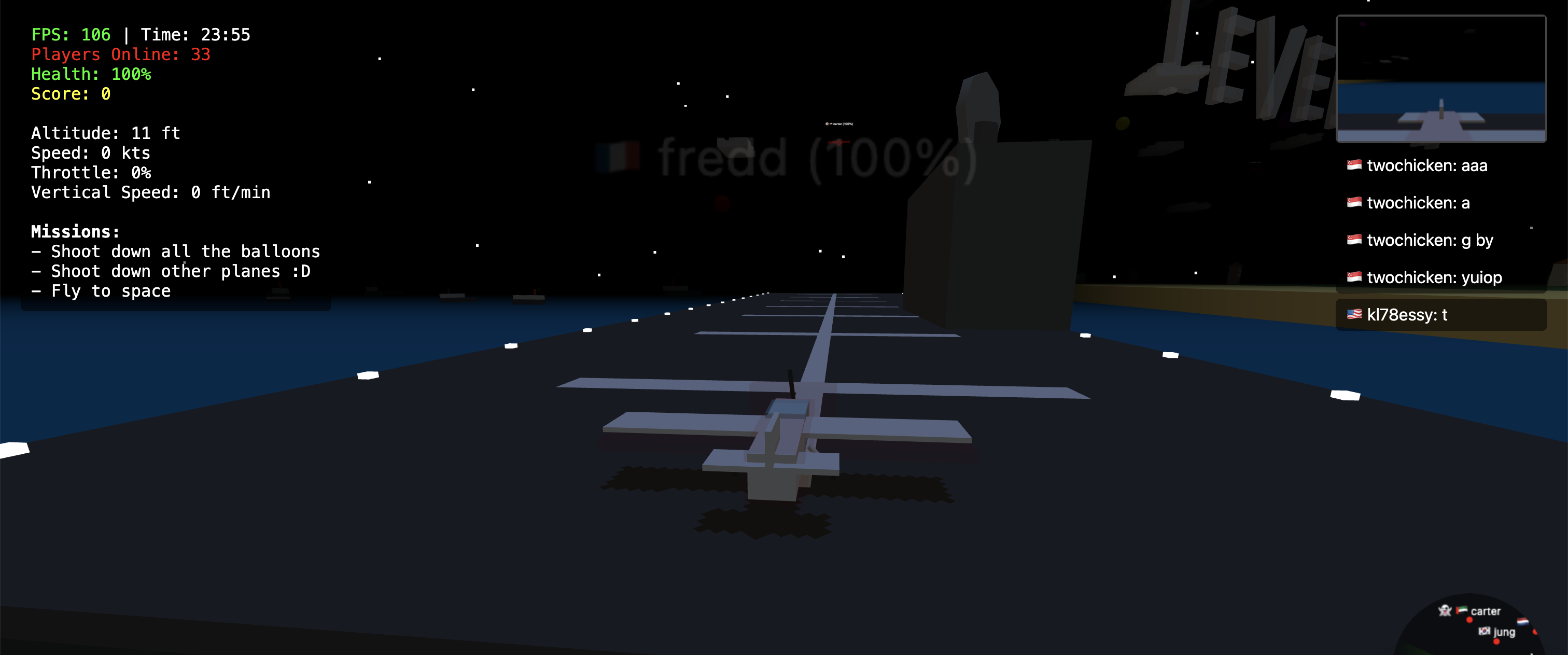 fly.pieter.com — the browser flight sim Levels vibe-coded in an afternoon, billboards and all.Nicolas Zullo — @NicolasZu
Small account, huge hit. WW2 Dogfight Arena (fly.zullo.fun) was a 3D multiplayer browser dogfight game he built in the wake of Levels' sim: by his own tally, "20 hours, 500 prompts, 20 euros… 1.5M views on X, 45k tested the game," all in Cursor with Claude and Grok. The proof that the flight-sim moment wasn't a one-person fluke. (Metrics self-reported.)
Riley Brown — @rileybrown.ai · @rileybrown
The most prolific vibe-coding educator on the internet, and co-founder of VibeCode — a mobile app that builds mobile apps from text prompts. Per Business Insider, VibeCode raised a $9.4M seed led by Alexis Ohanian's Seven Seven Six, with angels from Google, OpenAI, and Expo, and had powered 40,000+ apps at announcement.
Pietro Schirano — @skirano
CEO of MagicPath, an "infinite canvas" AI design tool whose launch drew ~1.8M views; version 2.0 turned it into a multiplayer canvas where humans and coding agents (Codex, Claude Code) work side by side. Raised a $6.6M seed led by Khosla Ventures. Previously at Anthropic, Brex, Uber, and Facebook; creator of Claude Engineer and DesignerGPT.
The Weird AI Toys & Games
 The freshest, strangest end of the spectrum — apps whose entire premise is a joke or a hallucination, and that's why they spread.
Fai Nur & the WishRoll team — Status AI
The Sims, but the entire social network is hallucinated by an LLM. You build a persona and live inside a simulated social feed populated entirely by AI characters. It went mega-viral on TikTok in early 2025 (the company reports 1M+ users in ~19 days). Per TechCrunch, Status raised $17M in combined seed and Series A from Abstract, General Catalyst, Union Square Ventures, Y Combinator, and LightShed. (User metrics self-reported.)
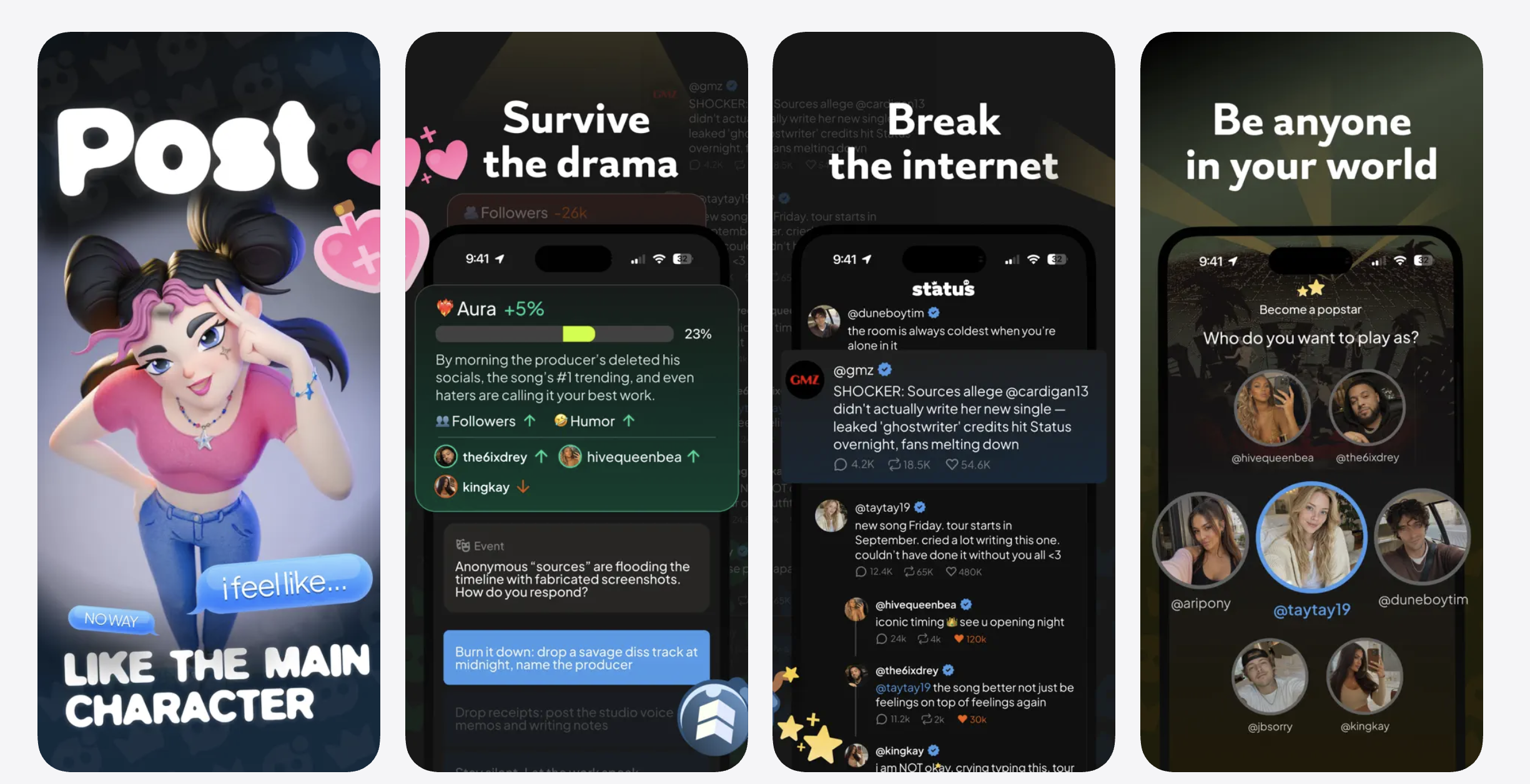 Status AI — a social feed hallucinated entirely by an LLM.mikidoodle — @mikidoodle
Built "Your AI Slop Bores Me," a reverse-Turing-test multiplayer game where humans LARP as AI — you answer prompts trying to sound like a soulless chatbot while everyone else guesses who's actually human. A Show HN front-page hit in early 2026, riding peak AI-slop fatigue.
The Decart / Etched team — Oasis
A fully AI-generated, playable Minecraft-like world that generates every frame in real time from your keyboard and mouse — no game engine, no persistent memory, so the world surreally morphs as you look away. Billed as the first playable AI-generated game, and the purest existing demo of software that literally rebuilds itself around what you just did — generative UI taken to its logical extreme. (Debuted late 2024; included as a reference point for where this is all heading.)
The Ship-It-Fast Indie Hackers
 The build-in-public crowd who turn "I made a thing" into a distribution engine — and increasingly let AI write most of it.
Hassan El Mghari — @nutlope
The model citizen of "ship a free open-source AI app every couple of weeks." His portfolio — RoomGPT, BlinkShot, ReceiptHero, restorePhotos, PDFtoChat — has reached millions of combined users. Leads Developer Experience at Together AI.
Theo Browne — @theo
Creator of the T3 Stack and CEO of Ping Labs; shipped T3 Chat and T3 Code (an AI coding harness). The most-quoted AI-native-developer voice on the internet — and, unlike most commentators, he actually ships the apps he opines about.
Yohei Nakajima — @yoheinakajima
Wrote BabyAGI, the ~140-line Python script that named an entire category — every "autonomous AI agent" traces back to it. A GP at Untapped Capital who builds in public relentlessly; recent experiments include the Pippin framework and a vibe-coded VCpedia.
Marc Lou — @marc_louvion
The most visible "twelve startups in twelve months" disciple: ShipFast, CodeFast, DataFast, and ~20 micro-SaaS, increasingly AI-assisted, all documented in public. (Revenue figures self-reported.)
Zaid Mukaddam — @zaidmukaddam
Mumbai-based and self-taught; founder of Scira AI (formerly MiniPerplx), an open-source agentic search engine built on the Vercel AI SDK. (Search-volume figures self-reported.)
Peter Steinberger — @steipete
Built OpenClaw (formerly Clawdbot), a locally-run AI agent that plugs into your messaging apps and executes multi-step tasks. It became one of the most-starred projects on GitHub in early 2026 before being acquired by OpenAI — a defining "AI can act, not just talk" moment of the year.
Sully Omar — @SullyOmarr
Co-founder of Otto / Ottogrid, an agentic-AI research-and-spreadsheet tool acquired by Cohere in 2025. Ships a steady stream of "direct AI agents like junior devs" demos. (Not to be confused with the unrelated healthcare company Sully.ai.)
Yacine — @yacineMTB
Creator of Dingboard, a fast, browser-based AI meme editor billed as "a free AI-powered meme editor that doesn't suck." Ex-Stripe, ex-X; a reliably chaotic, opinionated build-in-public voice. (Follower count self-reported.)
deepfates — @deepfates
Helped scale Replicate's open-source AI community and organized the WorldSim event that kicked off the "simulative AI" moment. Credited with helping popularize the term "AI slop," later Merriam-Webster's Word of the Year. His 2025 project Folio is a folder you share with Claude Code. (Cultivates an ARG-style mythology around his own identity.)
The Mad-Scientist Makers
 The people who make AI physical, or make it misbehave on purpose, for the joke.
Simone Giertz — @simonegiertz
The Queen of Shitty Robots, now with an honorary doctorate in informatics and a product line stocked at the MoMA Design Store. Her useless-machine ethos — build the ridiculous thing well — is the emotional core of this entire list, and her builds increasingly fold in ML.
Charlie Holtz — @charliebholtz
Made David Attenborough narrate your life through a webcam — Attenborough Narrator paired GPT-4 Vision with ElevenLabs voice cloning, and Business Insider said it "struck fear into the heart of Hollywood." A former Hacker in Residence at Replicate; the canonical "weird AI demo." (The Attenborough demo is late 2023 — included as a reference point, not a 2026 launch.)
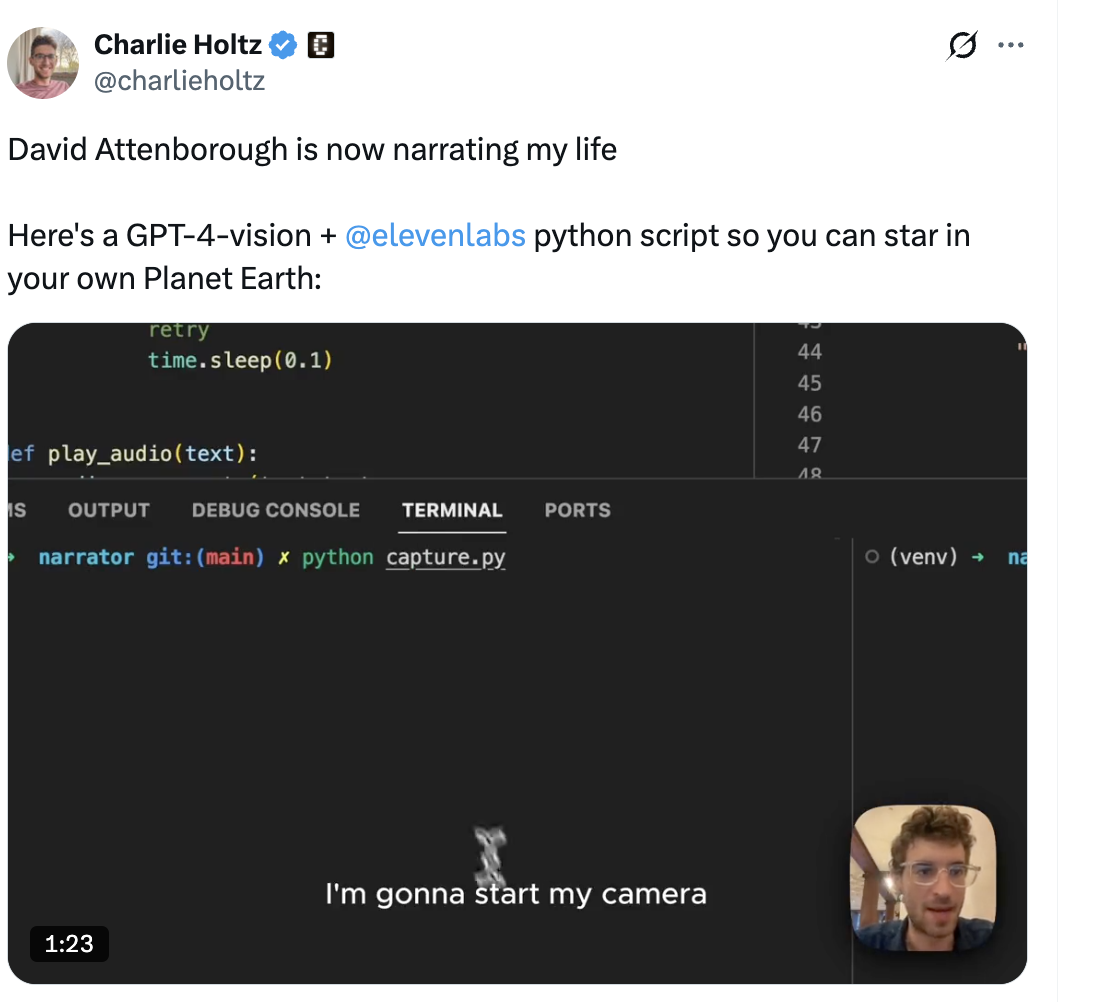 The original “David Attenborough is now narrating my life” demo.Ammaar Reshi — @ammaar
Now Product & Design Lead at Google DeepMind / AI Studio, where he shipped the redesigned vibe-coding experience. Known for viral AI experiments: an AI-illustrated children's book, and an AI-generated Mortal Kombat fan film made with Veo 3.
The Creative-Code Artists
 The people treating "software that responds to you" as an art medium — where a lot of the genuinely new visual ideas are coming from.
Zach Lieberman — @zach.lieberman
Co-creator of openFrameworks and the dean of creative coding; an MIT Media Lab professor whose decade-long daily "poetic computation" sketch practice got its own gallery show in 2025. Recently used LLMs to help write Metal compute shaders inside openFrameworks.
Matt DesLauriers — @mattdesl
Creator of the canvas-sketch framework and Art Blocks' Meridian collection — a thousand generative "landforms," with work now in LACMA's permanent collection. Increasingly working at the intersection of generative art and AI.
Sage Jenson — @mxsage
GPU slime-mold simulations so beautiful they've been copied across the whole creative-coding scene; "36 Points" is the reference piece. Artist-in-residence at Nervous System, translating live simulations into 3D-printed objects.
 Sage Jenson’s “36 Points” — GPU slime-mold, the reference piece.Olivia Jack — @ojack
Creator of Hydra, the browser-based, live-codeable, networked video synthesizer that's become a staple of the live-coding and algorave scene worldwide.
Char Stiles — charstiles.com
Live-coding GLSL shader performances at algoraves and festivals; an MIT Media Lab Future Sketches alum who built the collaborative site shader.place and presented a "FANTASY IDE" at ICLC 2025.
Manolo Gamboa Naon — @manoloide
The Argentine generative artist whose Processing-based color-and-geometry work anchors the field; still posting near-daily generative pieces.
Anna Lucia — @annaluciacodes
Berlin-based code-and-textile artist; "Generations" translated the Gee's Bend quilts into an algorithm. Had her debut solo show in 2025.
Etienne Jacob — @bleuje
Paris-based; makes the perfectly-looping animated "controlled chaos" GIFs that flood generative-art timelines — and open-sources the code behind them.
Memo Akten — memo.tv
AI/ML artist whose "Learning to See" had neural networks reinterpret live webcam input into painterly imagery years before real-time AI video was cool. Exhibited at the Venice Biennale.
Kyle McDonald — @kcimc
Creative-AI and computer-vision artist (Face Substitution, Exhausting a Crowd) whose recent work turns AI's watch-you-back quality into interactive, and pointedly critical, installations.
Lingdong Huang — github.com/LingDong-
Built wenyan-lang (文言), an esoteric programming language written in Classical Chinese with an IDE that renders your code as an ancient manuscript, plus {Shan, Shui}*, an infinite procedurally-generated Chinese landscape painting.
Saskia Freeke — @sasj_nl
Has posted a new piece of generative art every single day since January 1, 2015 — a streak still running into 2026 — and co-organizes Livecoding Sessions.
Why the Weird Stuff Matters
What connects a slime-mold simulation, a fake Attenborough, and a flight sim built in an afternoon? None of them are static.
The best of 2026's weird AI apps respond. They adapt to the person using them, in the moment, instead of shipping one frozen version to everyone. Oasis literally generates the next frame based on what you just did. Infinite Craft invents elements no one has ever seen. Status AI hallucinates a different world for every player.
That's the direction all software is heading: interfaces that reshape themselves at runtime, per person, as people use them. It's the idea we're building toward at Differ — infrastructure for software that adapts to whoever's using it. If this list nudges you to ship something weird this weekend, tag us. We'd love to see it.
Further reading: what adaptive software actually means →
Follower and reach figures are approximate as of early 2026 and change constantly. Revenue, user, and view counts marked "self-reported" come from the builders' own public statements rather than audited sources. This piece profiles real people and their public work; spot something out of date? Let us know.